Automation with Merlin Backoffice® Flex 4.0
MagicScénario: automation of repetitive tasks
Note: goto to our Youtube channel to view the same video auto-dubbed in English
The revolutionary idea
This version changes the way you work. Instead of repeating the same tasks every week, day, or hour on hundreds or thousands of products, you define your method once, then let it replay automatically according to a schedule or triggered by an event.
The idea is simple: fewer clicks, fewer oversights, fewer late corrections, and more time to manage your business rather than maintain your catalogue.
In concrete terms, the tool introduces a ‘scenario’ approach: your sequences of clicks and actions become reusable procedures.
Once you have completed your routine as usual, Merlin Backoffice ® Flex saves it, and you can then restart it whenever you want, on a selection, on a batch, or automatically according to a schedule.
What this brings you
For teams, this also helps to harmonise practices: it avoids variations in individual methods and secures processes.
The most immediate benefit is very tangible time savings on a daily basis:
Firstly, quality control becomes automatic. A simple example is the SEO field length alert. Rather than discovering truncated titles or meta descriptions that exceed the limit too late, a scenario can regularly check lengths, generate a list of products to be corrected, or even apply standardisation according to your internal rules.
Second, inventory management can become proactive. Deactivating out-of-stock products, putting them back online as soon as a restock arrives, or applying a different strategy depending on the type of product: these are typically tasks that get put off because they are tedious and end up costing sales or generating support tickets. Here, we can make it systematic.
When it comes to pricing, the benefits are even more apparent. A busy shop needs clear rules: margin according to stock, protect the margin on high-demand items, speed up the sale of overstock, round prices neatly, and maintain overall consistency.
A scenario can, for example, segment your products by stock level, apply a different margin rule, and then trigger a rounding to x.99 to finalise cleanly.
The mechanics of promotions can also be automated. Many merchants end up managing the visibility of discounted products ‘manually’ because keeping sale categories up to date is too time-consuming. A scenario can identify products for which a discount is currently applicable, automatically associate them with a ‘Current Sales’ category, and remove those for which the discount has expired. The result: a category that is always accurate, without spending time on it and without any unpleasant surprises. Another common case: export, modification, import. When you need to correct a field, restructure data, enrich a set of products, or perform a mass operation that does not exist natively in the back office, you often end up exporting, tinkering, re-importing, and then checking manually.
Here, we can formalise this cycle: targeted export, transformation, re-import, control. And above all, we can repeat it without fear as soon as a new wave of products arrives.
Finally, for those who already have automation flows, the availability of tools such as n8n is a game changer. One can imagine a flow that exports data to another database, triggers external processing (cleaning, reconciliation, price calculation, standardisation), and then re-imports the result.
Or even: automatically synchronise certain information between several shops, or feed a central repository.
It is no longer ‘Merlin on one side, automation on the other’, but a coherent chain. What makes this version truly different is not a list of isolated features. It's the fact that your habits become an automated process.
You don't start with a predefined scenario: you start with the way you work, record it, and turn it into a reliable, plannable routine that can be passed on to a team.
If you manage a large catalogue, have regular imports, promotions, stock variations and constant price adjustments, this is typically the kind of development that saves time from the very first weeks, while significantly reducing human error.
New graphical interface
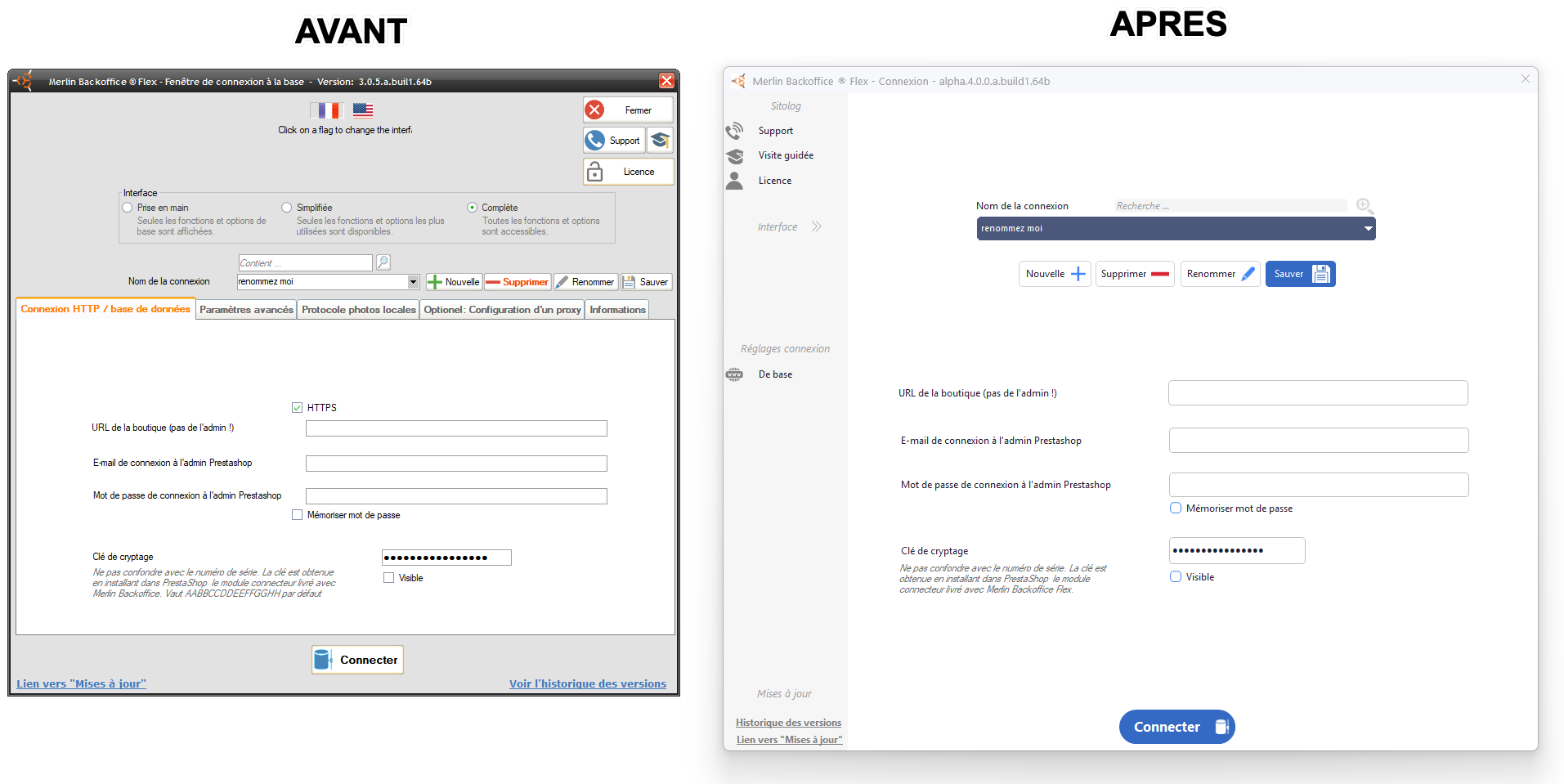
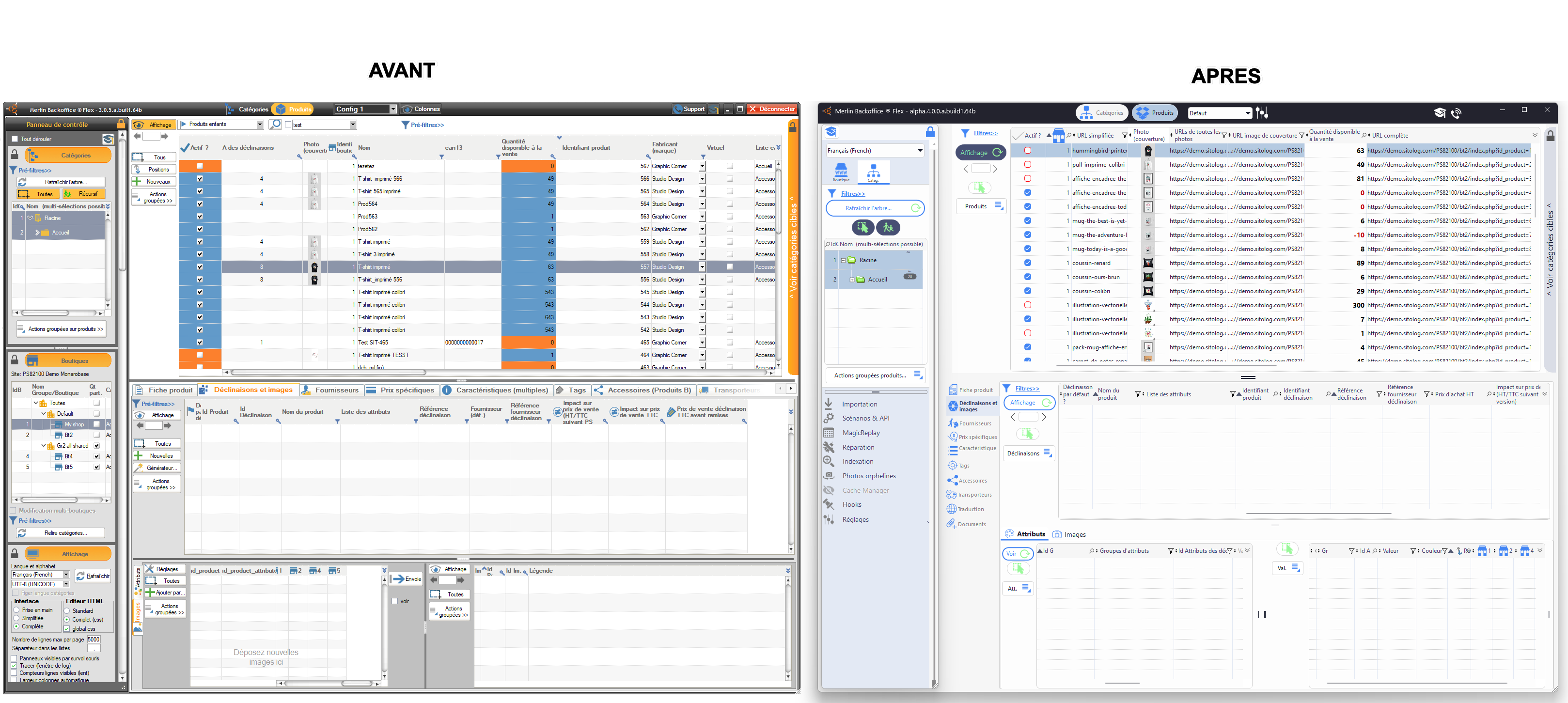
Version 4 also features a redesigned interface that is more modern, streamlined and intuitive.
The login window for versions 3 and 4 side by side:
The main window:
The import window:
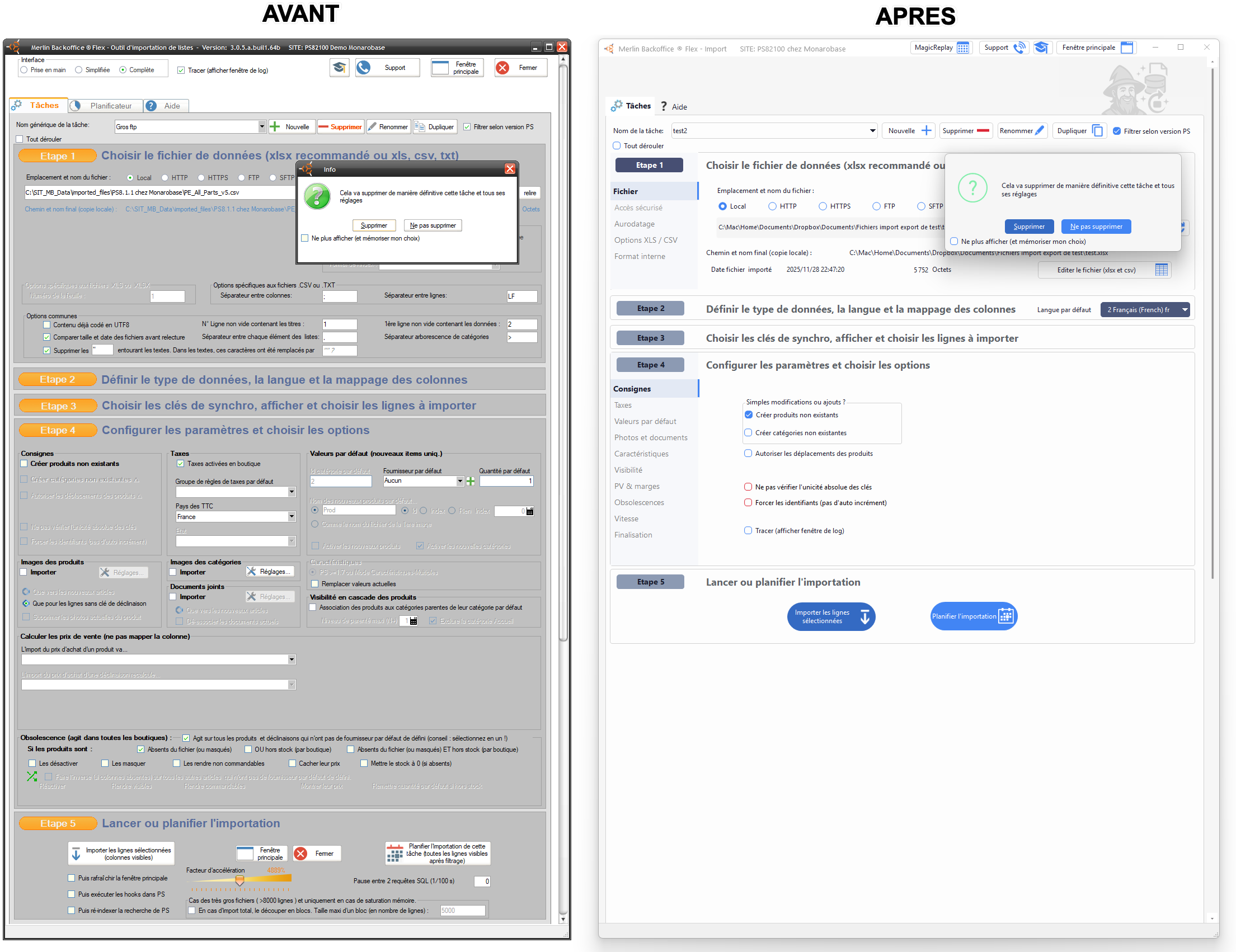
Much nicer, isn't it?
New AI features
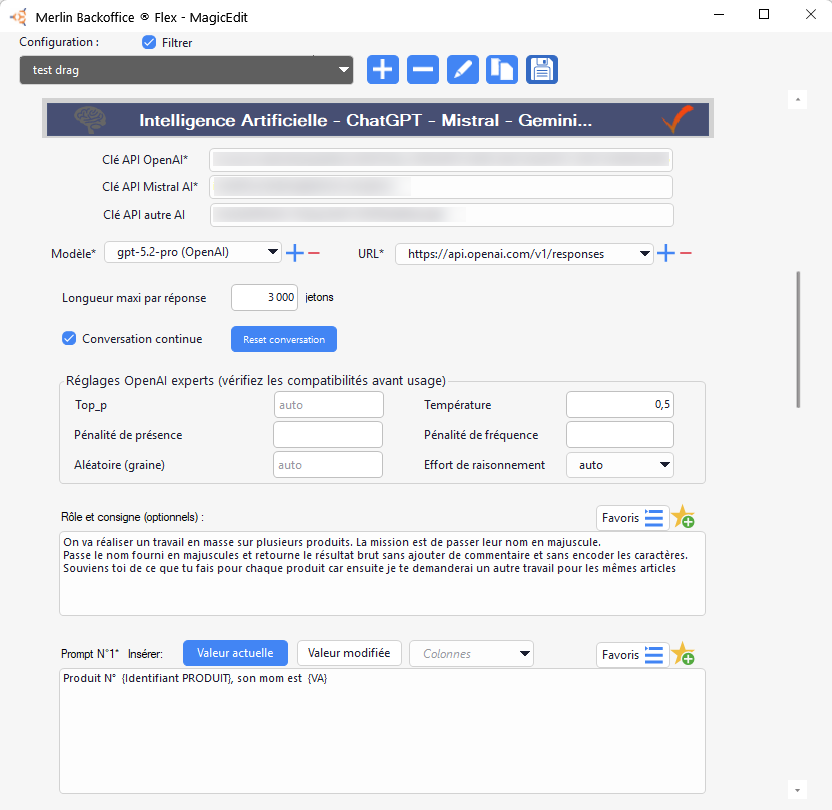
Sitolog was the first to include an interface to the ChatGPT API in its bulk catalogue management tool for PrestaShop in 2023.
Since then, AI engines have evolved considerably, making it necessary to rethink our interface to take advantage of these latest innovations:
- Support for ChatGPT competitors that are compatible with their API (Mistral AI, etc.).
- Three API key entry fields instead of just one.
- Automatic search for available LLM engines.
- Automatic search for URLs for the selected engine.
- Automatic configuration and management of usage limits.
- Use of ‘Deep Research’ engines, i.e. the ability to search for information on the web (competitors, suppliers, etc.).
- Memory of exchanges, can be enabled/disabled, can be reset.
- Saves tokens during multi-prompts by using AI memory.
- New advanced and optional AI settings (Top_P, penalties, seed, reasoning effort, etc.).